Sunday, October 25, 2026
Prefer to listen instead? The audio version of this article is available at relateecm.com.
This audio is AI-narrated and may mispronounce some names and places.
Well, howdy, friends. Thank you for being here today. I know your time is precious, and I don’t take it lightly that you’d spend some of it with me.
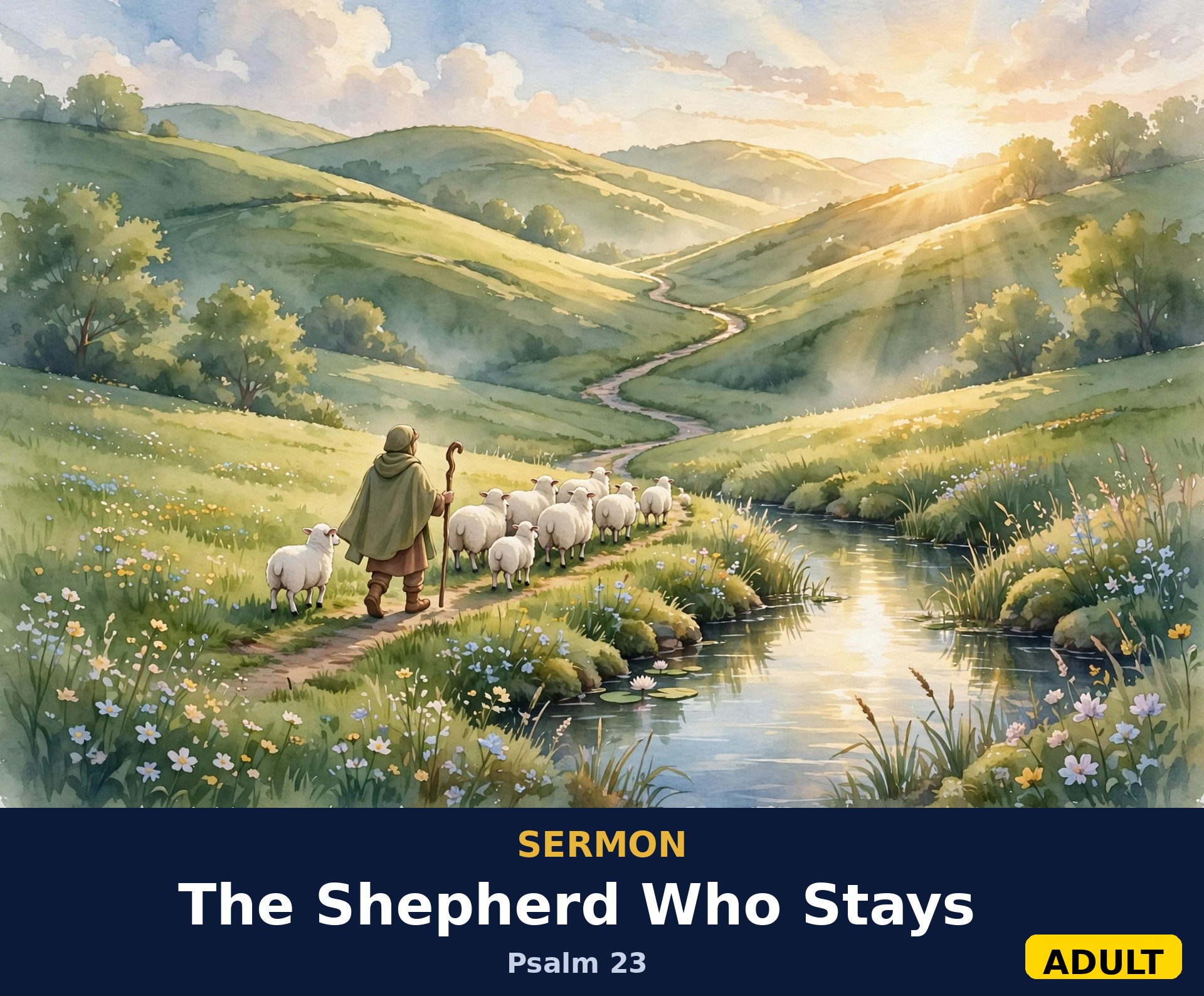
Today I want to talk to you about a Shepherd — not just any shepherd, but the one who stays. Through the green years and the lean years, through the mountaintop mornings and the long dark valleys — He stays.
If you have your Bibles, turn with me to the book of Psalms, chapter twenty-three. It’s only six short verses — most of us could read it before the coffee gets cold — but I’m telling you, there’s enough in these six verses to carry a soul all the way home. It’s a psalm of David, and it goes like this:
“The LORD is my shepherd; I shall not want. He maketh me to lie down in green pastures: he leadeth me beside the still waters. He restoreth my soul: he leadeth me in the paths of righteousness for his name’s sake. Yea, though I walk through the valley of the shadow of death, I will fear no evil: for thou art with me; thy rod and thy staff they comfort me. Thou preparest a table before me in the presence of mine enemies: thou anointest my head with oil; my cup runneth over. Surely goodness and mercy shall follow me all the days of my life: and I will dwell in the house of the LORD for ever.”
Now let’s walk through it slowly, the way you’d walk through a pasture early in the morning.
David starts with words that change everything: “The LORD is my shepherd.” Not a shepherd. Not the shepherd of somebody else down the road. MY shepherd. David isn’t reciting a doctrine here — he’s telling you about somebody he knows. A hired hand watches sheep for a paycheck, and when trouble comes, the hired hand has a decision to make. But the shepherd owns the sheep. They’re his. And David says the Lord is like that with him — and friend, He’s like that with you.
“I shall not want.” Now, that doesn’t mean God hands us everything we ask for — a good shepherd doesn’t give the flock everything it bleats for. It means the Shepherd sees to it that we have what we need. Sheep don’t lie awake worrying about tomorrow’s pasture. They can’t. They just follow the shepherd, and the pasture keeps showing up. Some of us spend our whole lives fretting over a tomorrow that the Shepherd has already walked through ahead of us.
“He maketh me to lie down in green pastures: he leadeth me beside the still waters.” Notice — He leads. He doesn’t drive. A shepherd walks out front, and the sheep follow his voice. And sometimes He has to MAKE us lie down, because sheep left to themselves will graze until they drop — and people left to themselves will work and worry until they drop. Some of the rest you’ve gotten in this life, the Shepherd had to insist on. And the still waters — sheep won’t drink from rushing, noisy water; it frightens them. So the Shepherd finds them the quiet water. Friend, if your soul is thirsty and restless right now, it may be because you’ve been trying to drink from every rushing stream this world offers. There is a still water, and the Shepherd knows the way to it.
“He restoreth my soul.” Restore — that’s a word for something worn down, used up, maybe even broken. Shepherds talk about a cast sheep — one that’s rolled onto its back with its legs in the air and cannot get up by itself. Left that way, it will die that way, in plain sight of the whole flock. But the shepherd counts his sheep. And when one comes up missing, he goes looking. And when he finds it cast down, he doesn’t stand over it with a lecture. He gently rolls it over, lifts it to its feet, and holds it steady until the strength comes back into its legs.
Somebody listening to me knows exactly what it is to be cast down — flat on your back, spiritually speaking, certain you can’t get up, certain everybody’s seen you fall. Hear me now: the Shepherd restores. And then — “he leadeth me in the paths of righteousness for his name’s sake.” He sets our feet back on the right path, not because we’ve earned it, but because His name is on us. The Shepherd’s own reputation rides on bringing His sheep home — and He has never yet lost one He went after.
Now we come to the valley. “Yea, though I walk through the valley of the shadow of death, I will fear no evil.”
Notice David doesn’t say IF I walk through the valley. Valleys are not a sign that God has packed up and left. They’re part of the route home. In the hills over there, there were narrow, shadowed passes a shepherd had to lead his flock through to reach the high pastures — dangerous ground, where wild animals waited up in the rocks. The shepherd didn’t apologize for the valley. It was the way through.
And notice what kind of valley it is — the valley of the SHADOW of death. Friend, a shadow cannot hurt you. The shadow of a dog can’t bite. The shadow of a sword can’t cut. Death casts a long shadow across this life, but for the Shepherd’s sheep, that’s all it can ever be — a shadow — because the Shepherd Himself has already gone into the real thing ahead of us, and come out the other side.
But here’s the part I want you to carry home with you. Up to this verse, David has been talking ABOUT the Shepherd: “he leadeth me,” “he restoreth my soul.” But in the valley, he starts talking TO Him: “for THOU art with me.” In the dark, God stops being a subject we discuss and becomes the company we keep. Some folks only learn that in the valley — and I’ll tell you plain, it’s worth the valley to learn it.
“I will fear no evil: for thou art with me; thy rod and thy staff they comfort me.” The rod was the shepherd’s weapon — a stout club to fight off whatever came at the sheep. The staff was the long crook — to pull a sheep out of a thicket and draw it in close. The rod says, “I will protect you.” The staff says, “I will not let you wander off.” Between the two of them, the sheep is covered on every side.
Now hear this: God does not promise to airlift us out of the valley. He promises something better. “Thou art with me.” The Shepherd stays. When the hospital corridor is long and the waiting room goes quiet at two in the morning — He stays. When the phone rings with the call you never wanted to get — He stays. And see David’s word: you walk THROUGH it. “Through” means the valley has an end, and there’s daylight on the far side. But you will never walk through it alone. Not one step of it.
Then David’s picture widens into a banquet hall. “Thou preparest a table before me in the presence of mine enemies.” Right in front of the very things that opposed him, God sets a table — not after the battle, not once it’s finally safe, but in the presence of it all. The Shepherd becomes the host. “Thou anointest my head with oil” — a shepherd put oil on a sheep’s head to soothe its scratches and keep the pests off; a host anointed an honored guest. Either way it tells you this: you matter to Him, personally, by name. And “my cup runneth over.” Not barely full. Not just enough to get by. Runneth over. That is a Shepherd who gives past the brim.
And David closes with the staying promise, running front to back through a whole life: “Surely goodness and mercy shall follow me all the days of my life.” Follow me — picture two good sheepdogs bringing up the rear of the flock, goodness and mercy, covering even the ground where you’ve already been. And then the last line — the finest address a soul can ever have: “and I will dwell in the house of the LORD for ever.” The Shepherd who stays with us in the valley stays with us for ever — and better than that, He brings us home to live where He lives.
Now, friend — maybe you’re listening, and somewhere down deep you know you’ve wandered. Sheep don’t usually mean to get lost. They just nibble their way off, one mouthful at a time, heads down, until they look up and the flock is gone and the light is going. If that’s you, I’ve got good news for you today: this Shepherd leaves the ninety and nine and goes after the one. He is going after you. You don’t have to clean yourself up to come home. You just have to stop running, and let Him carry you back. And if you’ve never given your life to this Shepherd at all, there’s no better day than today to say, “Lord, I’m Yours. Lead me, and I’ll follow.”
And you don’t have to find your way back on your own power, friend. A lost sheep doesn’t rescue itself — it cries out, and the Shepherd comes. Your part is the crying out. His part is the coming. And He has never once failed to come for a sheep that cried out for Him.
And listen to what Jesus said about Himself in John chapter 10, verse 27: “My sheep hear my voice, and I know them, and they follow me.” That’s the Shepherd of Psalm 23, friends, standing in the New Testament with a name and a face — the Lord Jesus. He knows His sheep. He knows your name, your valley, your whole story, and He calls you by it. And here’s the wonder of it: after all David said about pastures and valleys and tables, the whole psalm really hangs on those first five words — the LORD is my shepherd. If you can say that today, you can say everything else in the psalm after it.
Let’s pray together.
Father, we thank You for being the Shepherd who stays. Thank You for the green pastures, and thank You for never leaving us in the valley. Thank You that Your rod protects us and Your staff draws us close. Lord, for the one listening who’s worn down, restore their soul today. For the one who’s walking through a dark place right now, let them feel You beside them, step for step. And for the one who’s wandered off, go after them the way You always do, and carry them home. We’ll give You the praise for all of it. In Jesus’ name we pray — amen.
Thank you for spending this time with me, friends. Until next time, this is Uncle Ricky. God bless you — and remember: the Shepherd stays.
Leave a Reply